

Parameter of AZS Bricks
AZS brick is also known as fused cast zirconia alumina refractory brick. REBO offers three standard grades: AZS-33#, AZS-36#, and AZS-41# to suit different glass furnace applications. REBO produces fused cast AZS blocks using electric arc furnaces and precision molds. This special process creates a very dense crystal structure inside the bricks. Because of this, our AZS blocks offer outstanding mechanical strength. They resist strong molten glass erosion and chemical attack.
To streamline your sourcing process and meet all your refractory needs in a single purchase, we additionally offer a complete range of fused cast alumina blocks, including α-alumina block, α-β-alumina block, and β-alumina block. Contact us for TDS details.
| Item | AZS41 | AZS36 | AZS33 |
|---|---|---|---|
| SiO2, % | 12 | 13 | 15 |
| Al2O3, % | The Remainder | The Remainder | The Remainder |
| ZrO2, % | 41 | 36.5 | 33.5 |
| Fe2O3+TiO2+CaO+MgO+Na2O+K2O, % | ≤2.0 | ≤2.0 | ≤2.0 |
| Bulk Density, g/cm3 | 4.05 | 3.9 | 3.8 |
| Apparent Porosity, % | 0.6 | 0.8 | 0.7 |
| Initial Precipitation Temperature of Vitreous Phase, ℃ | 1400 | 1400 | 1400 |
| Vitreous Phase Exudation, %(1500℃4h) | 1.5 | 2.3 | 2.0 |
| Anti-molten Glass Erosion Speed Under Static Condition, mm/24h(1500℃36h, ordinary soda lime glass) | 1.2 | 1.3 | 1.4 |
| Bubble Release Rate, %(1300℃10h, ordinary soda lime glass) | 0.6 | 1.0 | 1.2 |


Types of Fused Cast AZS Bricks
| Dimension | AZS-33# | AZS-36# | AZS-41# |
|---|---|---|---|
| ZrO₂ Content | 33% | 36% | 41% |
| Glass Corrosion Resistance | Good | Superior | Maximum/Ultimate |
| Thermal Shock Resistance | Best | Good | Moderate (Requires strict heat-up curve control) |
| Key Applications | Upper structures, Tuckstones, Working ends | Main Melting Tank Sidewalls | Throats, Electrode blocks, Corners |
| Cost & Price | Highly Cost-effective (Standard) | Moderate | Premium (Precision-installed in critical zones) |
| Selection Rationale | Best thermal shock resistance & lowest cost. Ideal for upper/non-critical zones without high-velocity glass flow, maximizing cost efficiency. | Optimal balance of corrosion resistance & thermal stability. Long-term protection against chemical erosion and liquid-line wash in main sidewalls. | Ultimate resistance to high-temp erosion & rapid flow. Safeguards the most vulnerable “throat” zones to prevent premature failure and match overall kiln lifespan. |
| Other National Grades | ER-1681/BK-33/Monofrax S-3/ZB-33 | ER-1711/BK-37/Monofrax S-4/ZB-36 | ER-1682/BK-41/Monofrax S-5/ZB-41/ER 1685 (Special Grade) |


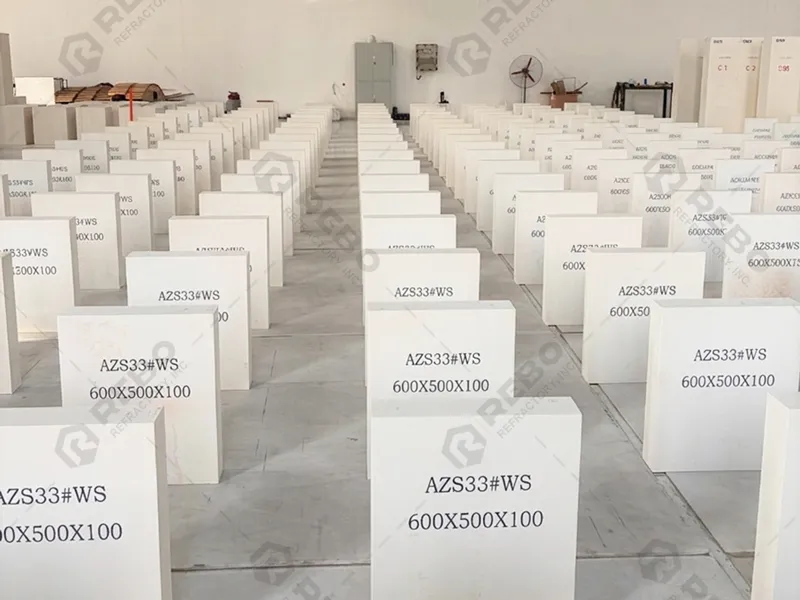


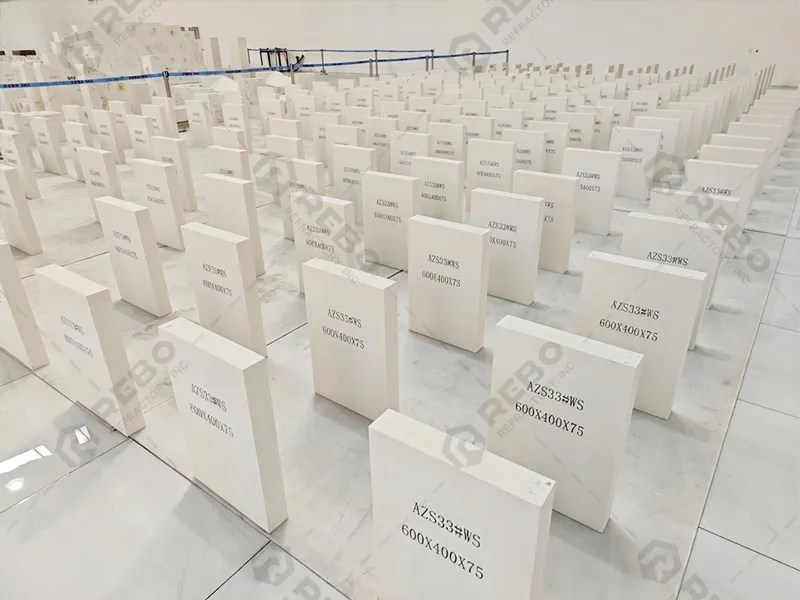
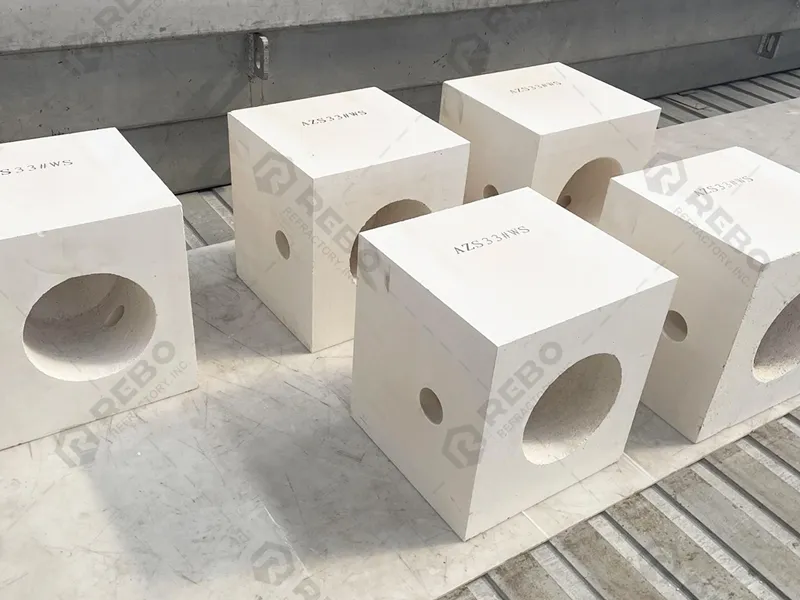

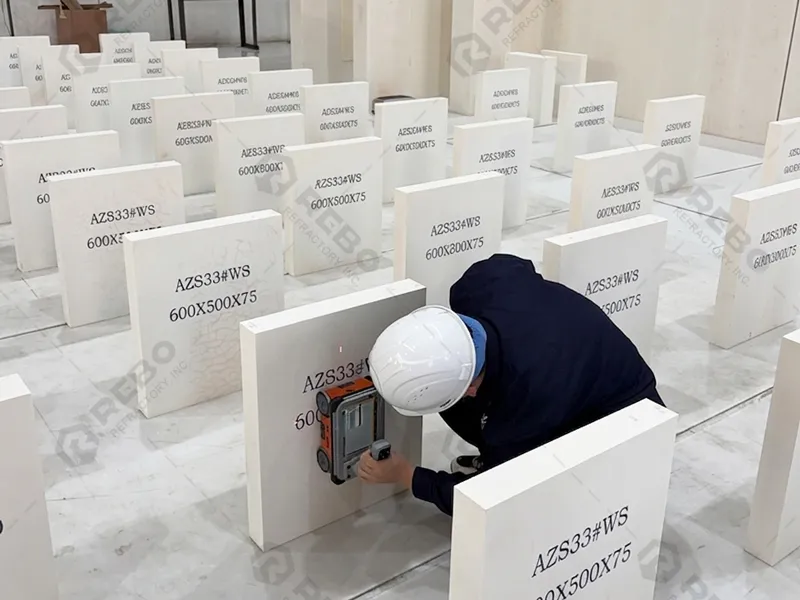
Advanced AZS Casting Methods Prevent Glass Leakage
Shrinkage cavities naturally form during the fused casting of AZS material bricks. Because different furnace zones face varying erosion levels, choosing the right casting method is key to maximizing service life and minimizing investment costs. REBO offers a full range of customized casting solutions (PT, QX, ZKS, WS) tailored to your exact operational needs. In addition, REBO also offers the following processes for furnace lining bricks:
- RR (Reduced Reboiling): Strong oxidizing melting and ultra-low foaming.
- LE (Low Exudation): Low exudation at high temperatures (≥1400°C).
- Low Fe/Ti: Total iron and titanium oxide content (Fe₂O₃+TiO₂)≤0.15%.
| ISO Code | Principle/Method | Price Index | Internal Density | Key Difference/Summary | Other International Code |
|---|---|---|---|---|---|
| PT | Natural cooling, no extra void control, default config. | ★★★ | Top cavity (15%–20% volume) | Lowest cost; for non-contact/low-wear zones | N/RC/NC |
| QX | Tilted/oriented cooling; pushes void to one side. | ★★★★ | One dense side, void on the other | Best value for single-side contact sidewalls | QX/KLP/TC/OC |
| ZKS | Uses insulated/extended riser for shrinkage feeding. | ★★★★★ | Reduced cavity (<5% volume) | Improved overall density; for medium-erosion zones | EL/ZS/RSC/RC/RT |
| WS | Oversized riser casting; void riser fully sawed off. | ★★★★★★ | 100% dense, void-free | Ultimate erosion resistance; highest cost & waste | DCL/VF/VFC/FC/KLB |
Precision Engineering for Zero-Gap Furnace Installation
For large-scale glass melting furnaces, even a millimeter of masonry error can lead to glass leakage or unexpected shutdowns. Beyond premium fused cast refractories blocks, REBO delivers end-to-end engineering services from secondary precision machining and factory dry-fitting to hassle-free delivery. This ensures zero-gap and zero-delay installation on your job site.
Part 1. Comprehensive Block Types & Custom Machining Capabilities
- Standard Tile & Straight Block: High-density foundational building blocks for standard layouts.
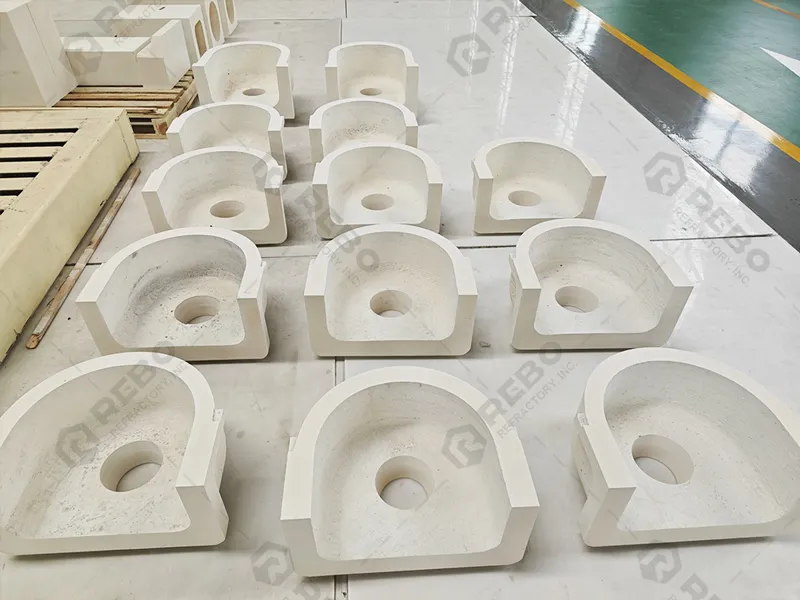
- Bevel Block & Special Shape: Throat blocks, doghouse blocks, crown blocks, burner blocks, electrode brick, bubbling blocks, etc.
- Customized Shapes: Custom-engineered to perfectly match unique furnace radii, crowns, and corners according to customers’ technical drawings.
- Drilled Holes (HOLE/Drilled): Precision-drilling for thermocouple ports and electrode insertion with zero edge micro-cracking.
- Precision Cutting (Cut/Sawed): Diamond-blade sawed to maintain strict dimensional tolerances within ±0.5mm.
- Notching & Grooving (Notch/Groove): Precision-milled joints that enhance interlocking tightness and prevent glass leakage.
- Edge Chamfering (CH/Chamfered): Precise corner edge-beveling to eliminate chipping risks and match structural clearances.
- Mirror-Image Identification (L/H & R/H): Clear Left-Hand and Right-Hand coding to eliminate reverse-installation risks on site.
Part 2. Rigorous Engineering & Drawing Reference System
- Drawing Reference (Draw No./Drawing Ref): Construction and machining drawing numbers (e.g., DRAW 4.3) clearly marked on block surfaces for easy tracking.
- Item & Position Number (Pos./Item No.): Strictly mapped to specific installation locations designated in the engineering blueprints.
- Zone & Section Coding: Explicitly categorized by application zones (e.g., Melt Tank, Working End, Throats) for maximum on-site handling efficiency.


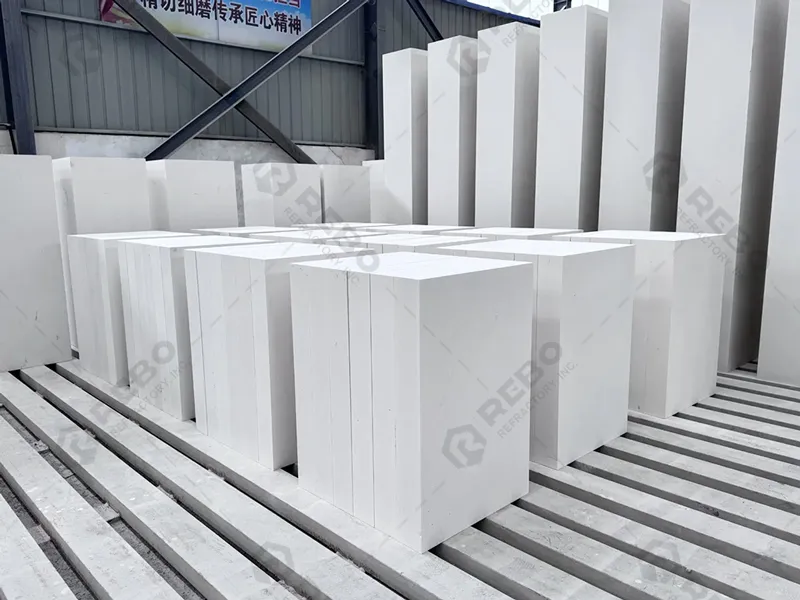
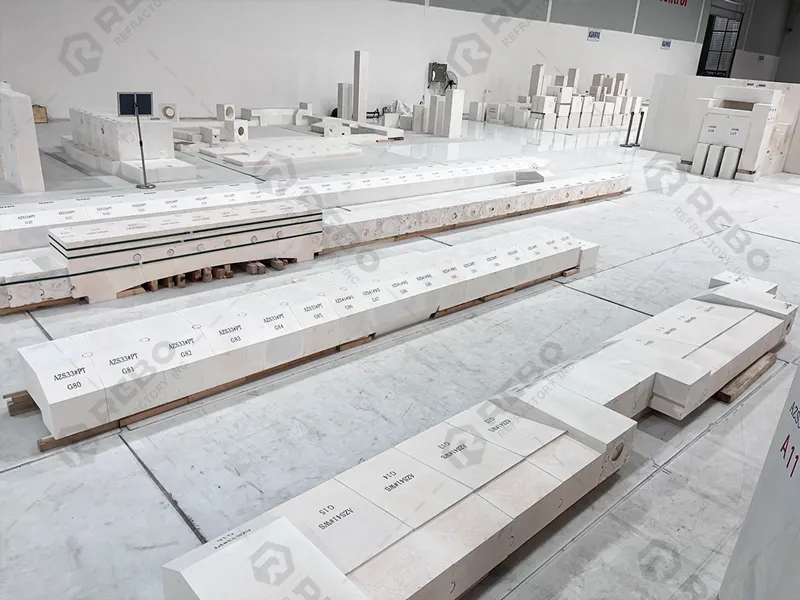


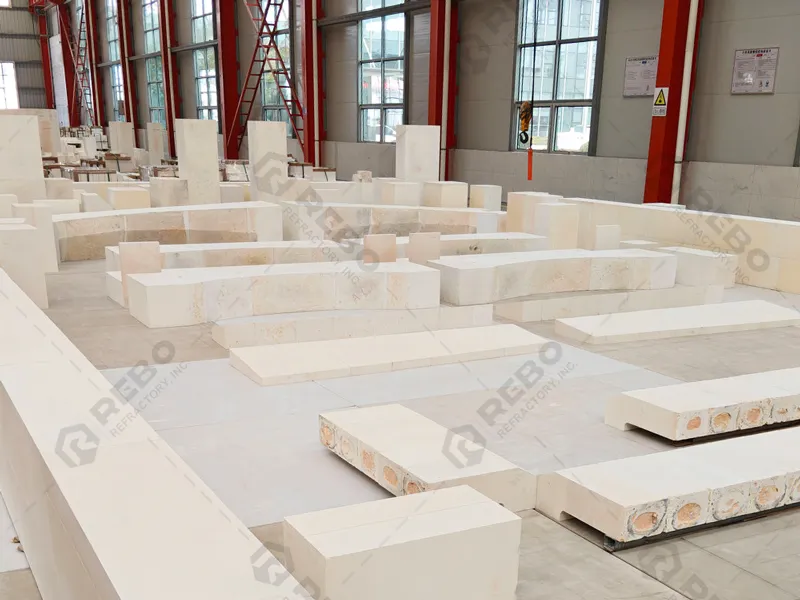


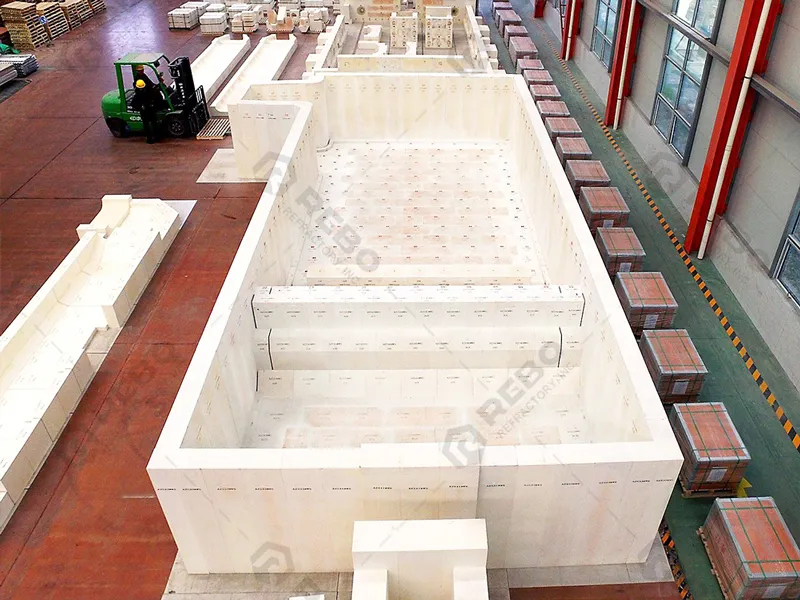
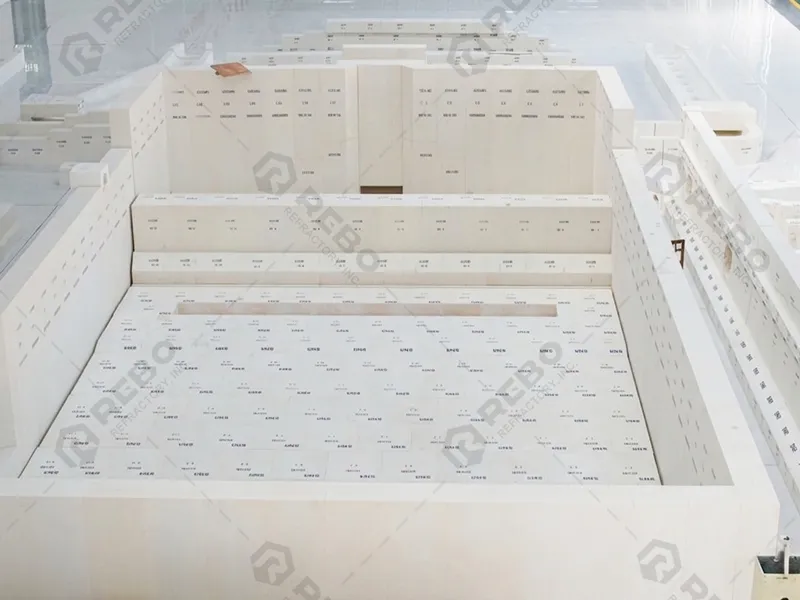
1:1 Pre-Assembly & Export-Grade Protection
- Pre-Assembly Inspection (Dry-Fit): 1:1 dry-fit assembly according to engineering drawings before dispatch. This ensures on-site masonry joints ≤0.5mm.
- Match Marks: Surface-applied alignment lines and sequential joint numbers (e.g., A1-A2) allow site crews to assemble blocks seamlessly. This cuts installation time by over 30%.
- Third-Party Inspection: Fully supporting pre-shipment alumina firebrick inspections by independent agencies like SGS/BV for dimensions, appearance, and physical properties with official reports.
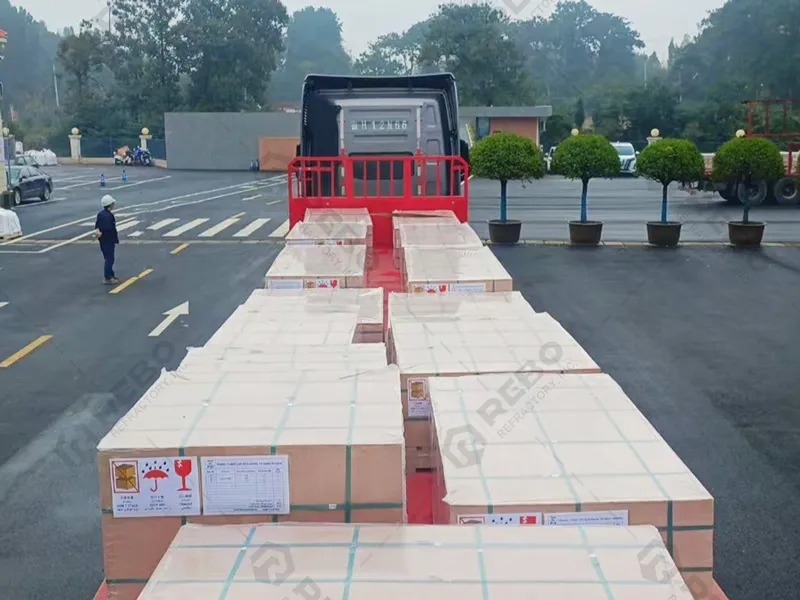
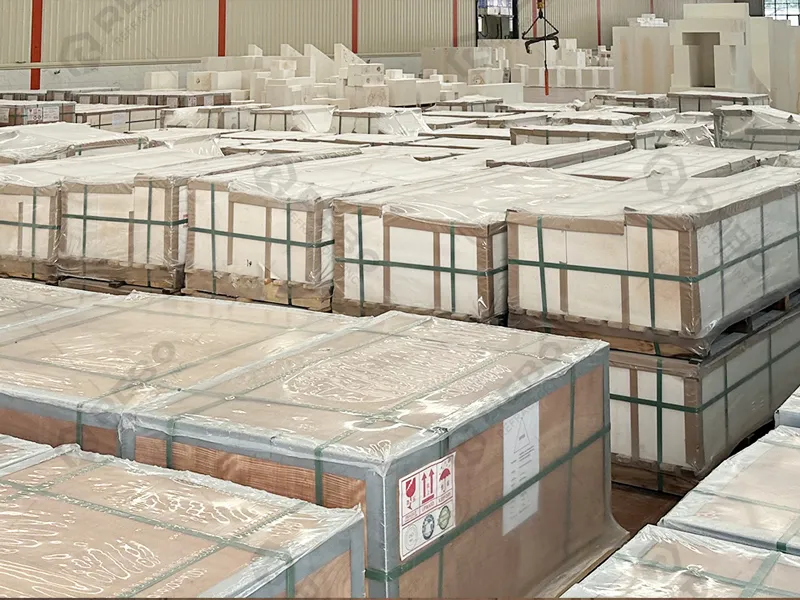
- Heavy-Duty Protective Packaging: Standardized in Fumigated Wooden Cases and heavy-duty steel-banded pallets equipped with edge protectors for superior moisture and shock resistance.
- Comprehensive Shipping Marks: Project Name, Block ID & Drawing No, Accurate Gross/Net Weight (GW/NW in kg/tons), Clear Handling Icons (Keep Dry, Center of Gravity, Fragile, etc.)
- Real-Time Cargo Monitoring: Customers receive dedicated tracking numbers and live vessel tracking links upon departure from the port. This allows 24/7 visibility over estimated time of arrival updates.






100+ Successful Projects Worldwide
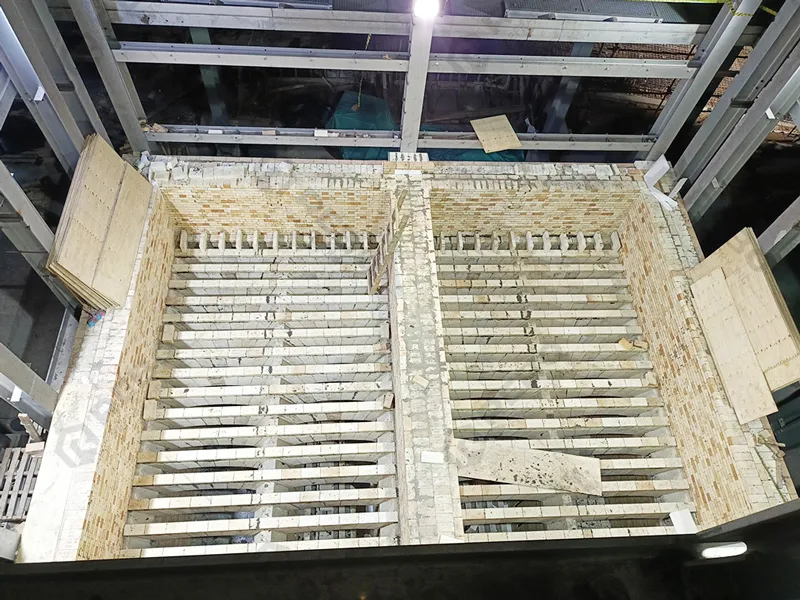
Beyond global reach, REBO’s core strength lies in optimizing the chemical stability and bulk density of every single block. By using high-purity raw materials and advanced electric arc furnace melting, our AZS bricks deliver superior resistance to glass liquid corrosion and thermal shock. With a proven record across 50+ countries and 100+ glass furnace projects, our engineered refractory solutions empower glass makers to achieve longer furnace campaigns and uninterrupted production with complete peace of mind.




Application of AZS Refractory Brick
Industry 1. Glass Industry
Electrofused zirconium corundum refractory bricks are widely used in almost all industrial glass furnaces, including float glass, electronic display glass, ultra-clear solar glass, container glass, pharmaceutical glass, glass fiber, and specialty optical glass furnaces.
A. Glass-Contact Zones (High Erosion & Severe Flow Areas)
| Furnace Position | Recommended Grade | Recommended Casting Code | Key Technical Requirement |
|---|---|---|---|
| Throat | AZS-41# | WS/DCL (Void-Free, Low-Bubbling) | Maximum erosion resistance against rapid melt flow; zero bubbling. |
| Electrode & Bubbler Blocks | AZS-41# | WS/DCL (Void-Free) | Resist localized extreme temperature, electrical field, and melt turbulence. |
| Doghouse Corners | AZS-36# or AZS-41# | WS/DCL (Void-Free) | Handle batch raw material impact, dust, and triple-phase boundary erosion. |
| Sidewalls (Upper & Middle) | AZS-36# or AZS-37# | ZKS/RT (Reduced Cavity) | Resist glass level line convection; offers cost-effective protection. |
| Sidewalls (Lower Level) | AZS-36# or AZS-37# | WS/DCL (Void-Free) | Ensure 100% dense structure; prevents glass leakage. |
| Bottom Paving | AZS-33# or AZS-36# | WS/DCL (Void-Free) | Fully dense block; stop downward drilling erosion from heavy impurities. |
B. Non-Contact Superstructure & Channels
| Furnace Position | Recommended Grade | Recommended Casting Code | Key Technical Requirement |
|---|---|---|---|
| Breastwalls & Tuckstones | AZS-33# or AZS-36# | PT (Regular) or RT (Reduced Cavity) | Withstand volatile alkali vapor and airborne batch dust carryover. |
| Gable Walls & Burner Blocks | AZS-33# | PT (Regular) or RT (Reduced Cavity) | Resist direct flame impingement and high-velocity gas thermal shock. |
| Forehearths & Feeders | AZS-33# (Low-Bubbling) | RT (Reduced Cavity) or LE (Low Exudation) | High exudation temperature; prevents glass phase sweating and defect bubbles. |
Industry 2. Metallurgy & Steel & Chemical & Environmental Industry
| Equipment & Position | Recommended Grade | Recommended Casting Code | Key Technical Requirement |
|---|---|---|---|
| Reheating Furnace Skid Rails & Discharge Chutes & Furnace Hearth & Slag Line & Tap Holes | AZS-33# or AZS-36# | WS/DCL (Void-Free) | High density and wear resistance; withstand steel slag attack and heavy mechanical abrasion. |
| Waste Incinerators Slagging Zone & Slag Tap & Chemical Reactors | AZS-33# or AZS-36# | WS/DCL (Void-Free) | Resist aggressive molten slag and severe chemical corrosion. |


REBO’s Production Capacity
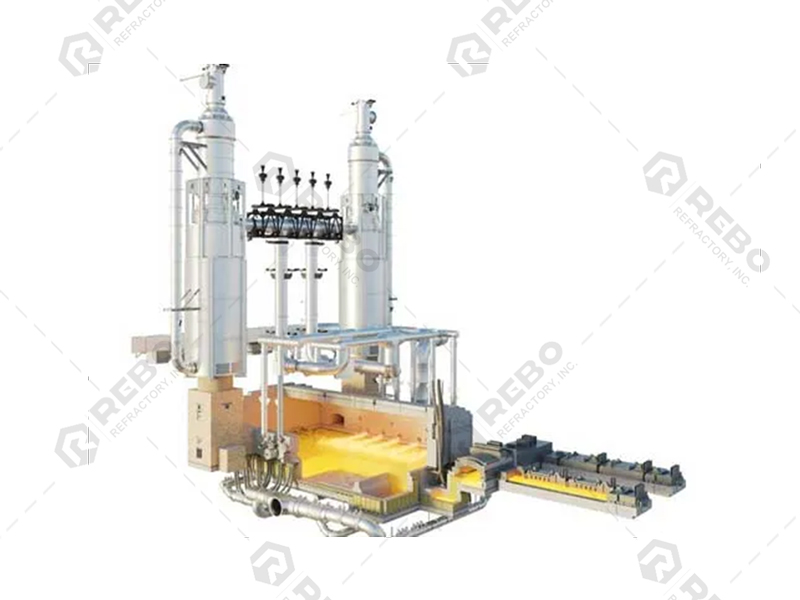
Fully automated arc furnaces with oxygen-blowing technology guaranteeing zero bubble defects and structural integrity for large-scale furnaces.
100% factory dry-fitting & numbering before shipment ensuring zero on-site fitting friction and rapid installation. Contact REBO for details.
Stringent GA/GC with complete MTC & third-party testing (SGS/BV) verified physical and chemical excellence.
End-to-end technical support from sepr equivalent cross-referencing & 3D drawing optimization to safe export packaging.



FAQs of AZS Refractory Brick
Q: What Are the Main Raw Materials?
Zircon Sand/Desiliconized Zirconia (provide ZrO₂ for corrosion resistance).
Industrial Alumina (provide Al₂O₃ for hardness).
Silica Sand (provide SiO₂ for thermal cushioning).
Q: How are Fused Cast AZS Bricks Made?
1. Raw Material Preparation: Mix pure zircon sand and alumina powder.
2. Electric Arc Melting: Melt materials at 2400℃ with oxygen-blowing technology.
3. Casting: Pour liquid material into molds (PT, RT, or WS types).
4. Demolding: Remove blocks after initial surface solidifying.
5. Controlled Annealing: Cool blocks slowly in PLC pits for 10–15 days to remove internal stress.
6. Machining: Cut and grind surfaces to exact dimensions.
7. Diamond Processing: Trim top cavities with diamond tools for precise fit (±0.5mm).
Q: Why Are High Density and Low Porosity Important?
Q: How Do You Test AZS Refractory Brick Quality?
1. Chemical Analysis: Check ZrO₂ content and low impurities.
2. Physical Tests: Measure bulk density and crushing strength.
3. High-Temperature Tests: Measure glass exudation temperature (≥1400℃).
4. Ultrasonic Testing: Detect internal holes and cracks.
5. 100% Factory Dry-Fitting: Assemble blocks in our plant before shipping.
Q: Are You a Real AZS Refractory Brick Manufacturer or a Trading Company? View some photos on Pinterest.
Q: What Factors Decide the Price of AZS Refractory Brick?
1. Zirconia Content: Higher ZrO₂ (41# vs 33#) costs more.
2. Casting Method: Void-free blocks (WS/DCL) cost more than regular blocks (PT).
3. Melting Grade: Low-bubbling oxidation grade (RR) costs more.
4. Machining Level: Full diamond grinding and dry-fitting add extra value.
Q: Why Are AZS Refractory Brick Critical for the Glass Industry?
Q: How Do You Use and Maintain AZS Refractory Brick?
Heating: Control temperature increases strictly between 1000 and 1200℃.
Daily Inspections: Check glass line erosion daily.
Maintenance: Use infrared cameras to scan hot spots. Apply air cooling to thin sidewalls.