Why Does Your Project Need Ceramic Fiber Modules?
Before vetting suppliers, clarifying why your project requires ceramic fiber modules will help sharpen your focus.
Compared to traditional refractory and insulation materials, the core advantages of ceramic fiber modules include:
- Superior thermal insulation efficiency: Lower thermal conductivity reduces heat loss from the furnace shell.
- Faster installation: As prefabricated lining products, the insulation layer is completed simply by securing the modules to pre-installed anchors.
- Lower long-term operating costs: Minimal maintenance time is required, reducing furnace downtime.
Consequently, ceramic fiber modules serve as an ideal insulation lining for the following scenarios:
Once the application scenario is defined, your evaluation of suppliers will naturally focus on key factors: temperature rating compatibility, dimensional accuracy, anchoring systems, lead times, and installation support.
Guidance of Choosing Reliable Ceramic Fiber Module Manufacturer
Verifying Supplier Authenticity
Check if the supplier’s business scope matches the business license they provided. Inquire about equipment and production capacity to see if the supplier can provide knowledgeable answers. Verify the authenticity of their industry case studies and export markets.
Comparing Key Technical Parameters
Further verify parameters such as the ceramic fiber module’s service temperature, thermal conductivity, weight per unit, and chemical composition. Ideally, the ceramic fiber insulation supplier should be able to provide laboratory test reports.
Validating Production Processes
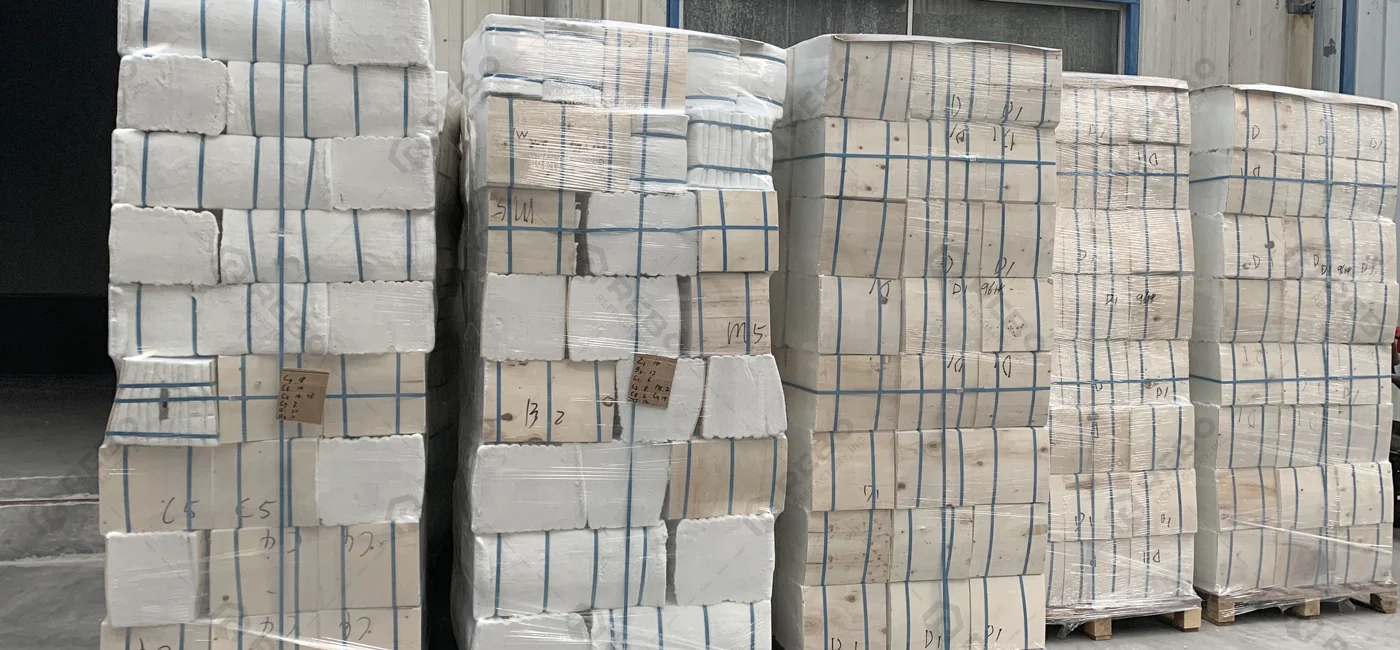
This is an area I believe clients should focus on closely. Ceramic fiber insulation modules are not merely cut; they require folding, compression, shaping, and securing with straps. If a supplier can explain how they fold and compress the modules while ensuring consistency across units, it demonstrates robust production workflows and effective batch quality control.
Deconstructing Costs Behind the Price
Common reasons for low prices include: low density, high shot content, low raw material purity, inferior hardware accessories, and rudimentary packaging. Compare quotes based on identical specifications rather than just the unit price. We all know that in the Chinese market, it is always possible to find a lower price. So you can ask the supplier for technical details to verify that the quality aligns with the price.
Assessing Service Capabilities
A mere trader will only describe the module’s density and dimensions. An experienced supplier, however, can recommend the appropriate service temperature, bulk density, and dimensions based on your kiln’s operating conditions. Try sharing details about your project—such as operating temperature, working environment, and potential chemical exposure—to see if their proposed solution aligns with your needs. Furthermore, a genuine ceramic fiber module supplier will also provide matching refractory anchors; professional module products often come with specific anchoring systems. If a supplier quotes only the modules without asking about your furnace type, temperature, or installation method, take this as a warning sign.
Installation Guidance
A quality module supplier’s service should not end at the point of shipment. At a minimum, they should provide installation guidance, recommendations for anchor layout, usage precautions, and more. Henan REBO Refractory published installation manual incorporates specific quality control checkpoints covering furnace shell inspection, anchor welding, anchor positioning checks, module installation, removal of packaging accessories, and surface treatment.
Quick Self-Checklist
| Check List | YES | NO |
| Real-Time Video Factory Inspection | ||
| Third-Party Test Reports | ||
| Explain the Folding and Compression Processes | ||
| Proactively Ask About Furnace Type, Temperature, And Installation Method | ||
| Provide a Matching Refractory Anchor Solution | ||
| Provide Installation Instruction Manual | ||
| Third-Party Quality Inspection | ||
| Reference Projects with Similar Operating Conditions |
If the answer to more than one of the above questions is “No,” it is recommended to evaluate the supplier with caution. Moreover, REBO is always glad to solve puzzles for choosing refractory and insulation products manufacturers.